

Peripheral Neuropathy at 75: How Mary Traded Her Walker for Sunrise Walks on the Beach
Note: Patient name changed to protect privacy.
Mary’s doctors told her that neuropathy only gets worse. Six months later, she was walking the beach at sunrise, collecting shells with her friends — proof that when treatment targets the nerves themselves, and not just the pain, feeling and function can come back.
When Mary first came to our clinic, she was 75 years old and getting around with a walker, moving slowly and unsteadily because her feet and lower legs had gone almost completely numb. She was, in her own words, petrified of falling. A walk on the beach — sand shifting underfoot, nothing steady to hold onto — was unthinkable.
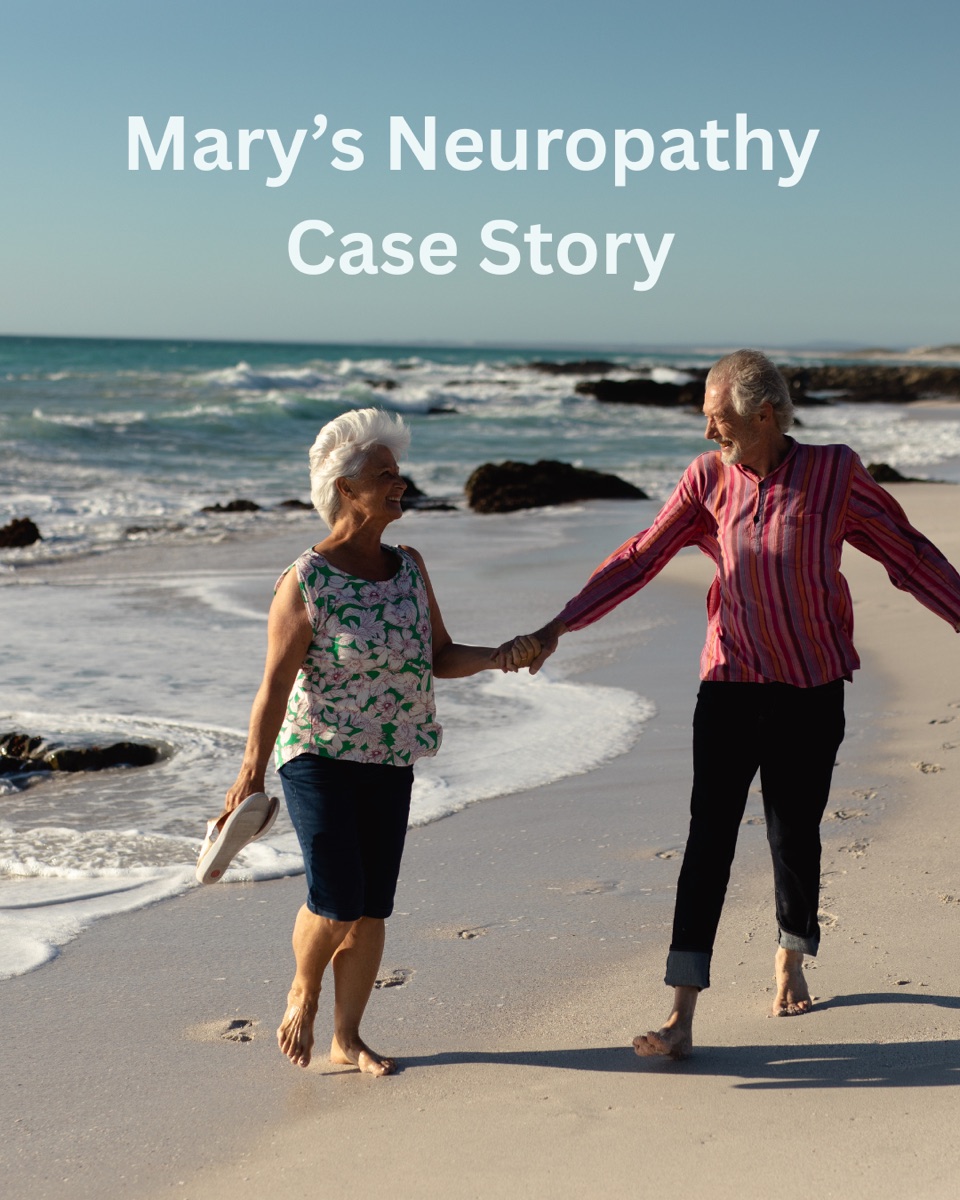
Six months later, Mary was actually able to take a beach vacation. She was up before sunrise, walking the beach and collecting shells with her friends. Today she gets around without her walker, drives herself where she needs to go, and is back to the outings and adventures she’d quietly stopped believing were still hers.
What Was Going On
Mary had been living with peripheral neuropathy (PN) for three years by the time she came to see us. It started as pain in both feet — she described it as “walking with sharp stones in my shoes.” Over time, that pain gave way to something she initially assumed was an improvement: numbness. Her feet and lower legs had lost nearly all feeling, and numbness was just beginning to creep into her hands
Her case was a textbook example of what we see in most of our peripheral neuropathy patients: idiopathic PN — meaning nerve damage that develops with age, without a clear trigger like diabetes, chemotherapy, surgery, or trauma.
As we do with every neuropathy patient, we started with a sensory exam to measure exactly how much feeling Mary had lost in her feet and hands. It’s a simple, hands-on exam, and not the least bit painful (unlike the electromyography (EMG) nerve studies a neurologist might order, which many patients find quite uncomfortable). Mary’s results were striking: 96% sensory loss in her left foot and 91% in her right. Her nervous system was sending almost no signals back to her brain from either foot. She couldn’t feel the ground beneath her. Her hands showed early signs of the same damage — 28% sensory loss on the left, 14% on the right.
What Brought Her In
Foot pain is what brings most peripheral neuropathy patients to our clinic for help. But it wasn’t what finally brought Mary through our doors. It was her hands.
Mary had watched her PN advance for three years, through her primary care doctor, a neurologist, an orthopedist, and a podiatrist, all of whom told her the same thing: neuropathy comes with age, it can’t be improved, only managed with meds. She was prescribed a rotation of medications — gabapentin, Lyrica, Cymbalta — aimed at dulling the pain signals. But what none of those medications could do was heal the damaged nerves. (We take a closer look at what these medications actually do — and don’t do — in a companion post.)
By the time the numbness reached her hands, Mary understood exactly what was at stake. She knew that if she lost the use of her hands the way she’d lost feeling in her feet, she’d lose her independence with it — the ability to dress herself, cook, play cards, and enjoy a meal out with friends. Mary had already had to give up on so much of what she loved, she wasn’t going to let PN rob her of friendships and her last bit of independence.
It’s worth pausing on something Mary said, because we hear a version of it from nearly every patient: she assumed the numbness was easier to live with than the pain had been. Clinically, it’s the opposite. Pain is the nervous system still sending signals — however uncomfortable. Numbness of the kind Mary had means those signals have stopped almost entirely. For an older adult, that combination — no feedback from the feet, unsteady balance — is a serious fall risk, and a fall that leads to a broken hip can set off a cascade of surgery, extended rehab, and lasting decline. Mary had already given up driving and was walking with a walker specifically to guard against devastating accidents.
Our Approach
We use a combination of electroacupuncture and ATP Resonance BioTherapy® to support nerve healing and regrowth — a different target than the medications Mary had already tried. Rather than dulling pain signals, this combination is designed to calm inflammation around the damaged nerves, improve blood flow to the area, and stimulate the nerve tissue itself to repair.
Because Mary’s PN was advanced after three years of progression, we told her upfront to expect roughly six months of consistent treatment to get lasting results. That’s a long runway, and it meant she had to keep showing up well before she felt any different — a genuine act of trust on her part.
Mary’s Six Months
Within the first three months, Mary noticed the numbness in her hands starting to recede. She assumed she was imagining it — until her monthly sensory exams confirmed the change was real. By month four, she’d traded her walker for a cane and was walking with more confidence. By month five, she was back to lunches and trips to the mall with friends, no longer feeling, as she’d once put it, like she was “holding them back.”
By the end of month six, Mary’s sensory loss had dropped to 28% in her left foot and 25% in her right — down from 96% and 91%. Her hands showed the same trajectory: from 28% and 14% sensory loss down to just 8% and 6%.
Where Mary Is Now
Peripheral neuropathy is a progressive condition, and we’re careful not to promise a “cure.” But our treatment approach repairs the damaged tissue driving PN’s symptoms, and for most patients, that translates into real, lasting gains in mobility and safety. After the intensive phase, patients like Mary continue with periodic maintenance treatments to protect their progress and keep their nerves functioning well.
Mary still comes in for maintenance visits, and we expect her sensory numbers to keep improving over time. For now, she walks, drives, and strolls the beach at sunrise with confidence — all things that felt out of reach three years into her diagnosis.
If Mary’s Story Sounds Familiar
If you’ve been told that neuropathy only gets worse, that there’s nothing to do but manage it, Mary’s story is a reason to ask more questions. A 2024 systematic review and meta-analysis of fifteen randomized controlled trials (1,186 patients) found that acupuncture not only reduced neuropathy pain more than sham treatment, but also improved how quickly signals travel along both sensory and motor nerves, evidence the researchers rated as high certainty (Wang et al., Complementary Therapies in Clinical Practice, 2024). While that review focused on diabetic neuropathy, it tracks with what we see in patients like Mary.
Peripheral neuropathy doesn’t have to be a one-way road. If numbness, pain, or balance problems are creeping into your life, peripheral neuropathy treatment in Vienna, VA may be able to change that trajectory.
We offer a free in-person consultation at AcuPoint Wellness Clinic in Vienna, VA — serving patients throughout Northern Virginia including Fairfax, Oakton, Herndon, Reston, and Alexandria. No pressure, no obligation. Just an honest conversation about what’s possible. If neuropathy is taking pieces of your life, we’d like to help you get them back.
Call us at (703) 459-9544 or request a free consultation at acupointclinic.com.
Sources
- Wang C, Fan Y, Liang G, Wang Q, Gao H, Duan J. “Acupuncture for the treatment of painful diabetic peripheral neuropathy: A systematic review and meta-analysis.” Complementary Therapies in Clinical Practice, 2024;57:101889. PMID: 39079232